Showing posts with label grandmothers. Show all posts

Thursday, July 19, 2018

Messages

On vacation last week.

It was a mini-vacation, tacked on to picking up Middle from camp and taking Oldest to freshman orientation (yes--we are there, and it feels both unreal and part of a natural progression and that is all my heart will let me say about it right now.) And our mini-vacation was a highly imperfect thing for many reasons, but now, a week out, the glowing moments stand out and the less-glowing will hopefully/probably join the canon of remember whens we can mostly laugh about now that they are at a safe distance. Now, a week out, the glowing moments are scattered generously through our trip, and our day in Cuyahoga Valley National Park shines especially bright.

It is right and good, that in a beautiful place set aside for wild and wonder and exploration one will find messages. Subtle, overt, intentional, imagined, serendipitous--there for the receiving. And for answering. We found the first four below. The last was Youngest's answer. May we remember it all.


Subscribe to Dreamer by Email

Friday, February 2, 2018

Pasta with Squid Ink Sauce


Hours after moving our son into his dorm room at an arts boarding school a year and half ago, my husband and I sat down to one of the most delicious and memorable meals of my life. I was heartbroken and terrified--our boy was young and it felt way too early to have him away, despite the fact that he had initiated it and that after much soul-searching we were all convinced it was the right move for him. The dinner fixed nothing, but the sheer warm magnificence of it was something of a balm, the way light glitters off broken glass and reminds you that despite the shattering there is still beauty to witness. We ate wonderful things, including a pasta in squid ink sauce, which, despite a warning from our waitress, I ate without tucking a napkin into my shirt. I admit it, I fully believed I had learned to eat without dribbling. And I not only dribbled, I dropped a big piece of pasta right down the front of my shirt, and the black stain is never going to go away. I could not throw the shirt away, and I could not look at it for a long time, either, so I tucked it deep in my closet with all the other things I do not know how to deal with. Something in me remembers at times like this that I am a slow-simmerer. Finally the thought struck me that I could cover the stain even though I could not remove it, and I found tucked nearby one of the lovely vintage handkerchiefs I brought home from my grandmother's house after she died. And I sewed the two heartbreaks together, and it took a very long time, longer than I thought it should have, but look I have made a new beautiful thing and someday I will wear the people I love who I can no longer have close by. 


Subscribe to Dreamer by Email

Tuesday, May 27, 2014

Found: "Sure, I can use that."


The box must have been among the last things we were sorting through after Gram died. Thread, pins, knitting needles—I had those at home, but thread is always useful, the supply of pins was diminishing, I don’t have every size knitting needle. Besides, you never know what tools you might need for mending, sewing, creating. You never know what might need to be held together.

Four years later, and I have not yet incorporated her tools into mine. Not exactly. Two pairs of knitting needles have gone to Middle and Youngest, along with bright thick yarn and once-in-a-while knitting lessons.

This seems fitting, since Gram is the one who first taught me to knit. I remember very little about the process, except that it was slow and I found it confusing, especially when it came to purling. I vaguely remember mint green variegated yarn, although that may have been a different project. Whatever color it was, that first piece was never finished. But years later when I decided to again try knitting, there was something still there from those first lessons. With memory for a guide it was not quite like feeling my way in the dark, and I stuck with it a tiny bit longer—until I decided I was too busy for a hobby. Adulthood was like that for me—I treated it for years like a narrowing.

A few years and two children later, I decided maybe a hobby was the thing. And my third try at knitting stuck. Most of what I know now has come from puzzling through books of patterns from the library, but I still count it as a gift from her, this widening of my adult life. My knitting lessons with her were brief, as were our forays into sewing and embroidery. I imagined them for years as failed attempts. The projects we started together were never finished. My interest in them diminished.

And yet.

She taught me enough about each of these things to bridge many years. Maybe she knew what it would mean to me—the joy of color and texture, the soothing nature of the work, the life-changing lesson that works its way into your soul: Sometimes the only way to have that beautiful thing you want is to make it yourself. I took up knitting several years before she died, but it seems there were always other things to talk about, so many other people around. Now I can only guess. It is a slender connection to her, I suppose, but that is the magic of knitting, itself: how you take a single long strand, humble thing, and work it into something else—solid, complex, warm.


Subscribe to Dreamer by Email

Monday, February 24, 2014

Week's Work


Over the course of a few days: freezing rain, then snow, then bright sun, warmth and melting. Midnight thunderstorms and water in the basement. Then fog. Then hail. And sun again.

A chance to run outside (twice!) and to feel overly-warm. Puddles to splash through, cool water seeping into my shoes. It felt good. Seeing a robin felt good, too, although hard to believe. The warmth was only a few hours old—did this bird rise up out of the ground?

Sick children. Time together.

Time spent working with my hands. Learning new things, and falling in love with the process.

Antsy students, which translates into chaos mixed with short brilliant moments of learning.

Watching my children respond to others’ deep hurt, and being reminded (again) how very, very fragile it all is.

The chance to take part in the celebration of a life that was full and too short. I did not know her. But now in a way I feel like I do.

More sickness—me this time—twenty hours in bed, and the kindness of my family. Small gifts to treasure: an eleven year-old who was proud to make lunch, a Cadbury creme egg, a read-aloud from the Captain Underpants book of the day. Those hours weren't lost, I've decided.

Monday again, gray sky. New resolve to learn this life as well as I can. Thinking about how sometimes what we're doing looks like staggering, and sometimes it looks like dance.


Subscribe to Dreamer by Email

Wednesday, December 18, 2013

Light, 12/18/13: Chiaroscuro


Sometimes you find yourself having conversations with the light. Not out-loud conversations, not prayers, not silent back-and-forth, but conversations nonetheless. Because maybe you are going around the house in the morning, trying to be nice and loving, but the dark mood from yesterday lingers, maybe even grips you hard. And you walk into a room and the sunlight pouring in fresh and new across the room draws your attention to things that matter to you: the tree Middle dug up from the yard two years ago, which she moves from room to room and decorates faithfully at Christmastime; a photograph of your spirited, redheaded grandmother that knocks you over with its stateliness; your ugly-but-faithful warm mittens.

They are lit-up, their shadows dark on the wall.

By the way, she wasn’t perfect, either. The light speaks honestly but gently.

True, but we all loved her anyway.

It helps, in the same way pulling out a toy can sometimes distract a child from her tantrum.

Mood lifted? Not exactly. But if you can shift with the light that is something. Silently you thank the light for sharing this.


Subscribe to Dreamer by Email

Monday, September 24, 2012

Mosaic


I was working on September Birthday Cake No. 4 yesterday (Middle’s, chocolate with cream cheese frosting, decorated with strawberries and hearts) and pondering musical memories when I opened the cupboard over my stove and got showered with pearly cake decorations. Now, I have a habit of thinking that if I can get a door or lid or suitcase closed it means that whatever’s inside fits. I am sometimes wrong. At least this time when something came flying out at me I didn’t have to get stitches. (I also have a habit of using my stovetop as extra counterspace, and then not paying close-enough attention to which burner I turn on. It hasn’t happened for a while, but can you see the partially-melted handle on the scissors in the background? Yeah.)

So I looked at my mess, the pearly cake decorations and scissors with the partially-melted handle, and had a dark moment in which I decided I was looking at clear evidence of what a mess I was in general.

And then I looked at my mess and thought, “Those pearly cake decorations look very pretty spilled all over the black stovetop.”

*       *       *

Before my little mess I had been thinking about how pieces of things lodge themselves in your soul and become part of you, maybe in ways you don’t even realize. How it seems, sometimes, that we are completely made up of fragments.

*       *       *

Take the Mozart Violin Concerto in A Major. Learning it in college was like learning no other piece, ever. I felt like I already knew it, like I was re-learning it. I have felt that way before, especially as a child, with pieces I’d heard older kids play so often that I knew the notes inside-out before I started “working” on them. But this concerto was a much more extreme case. I’ve never learned anything so effortlessly. I actually called my dad, to ask if I’d somehow worked on it before and simply forgotten.

It turns out that when I was an infant my parents played an Oistrakh recording of this concerto for me every day. For months and months. Once, when I was 3 or 4 months old, my mom left the house to run a short errand while I was taking a nap. My dad was practicing Bartok, getting ready for a performance. And I woke up almost immediately, and cried and cried. Hoping to not lose rare practice time, my dad switched to "my" Mozart concerto, and I calmed down and smiled. So he switched back to Bartok. And I started crying. And we went back and forth for quite a while, between Bartok and Mozart, crying and smiling. To this day my dad is certain I knew the difference.

Somehow this piece is part of me—it is my piece—more than any other.

*       *       *

There is other music like this, too, though—fragments that have taken hold.

The Dream Pantomime from “Hänsel and Gretel,” by Engelbert Humperdinck, for example. I’m not sure how many Decembers I accompanied my parents to their performances of this with the Minnesota Opera, but in my head the music melds with Christmastime, and slushy parking lots, and the sound of my boots clunking through backstage hallways, and entering the theater by climbing out of the orchestra pit, and sitting next to my sister trying to figure out which angel surrounding Hänsel and Gretel was the one we knew, the son of one of the horn players in the pit with my parents. By 1:24 in the Pantomime I am ten years old again and there in the darkness with those lost children; danger and hurt and hope are rising up together around them, and around me and my sister, as well. When I finally played this opera as an adult, I suddenly understood where so much of my taste in music comes from.

There is, also, the memory of my grandparents’ house one summer, not being able to sleep because I could not breathe, and how it felt—sitting with my grandma on her porch on a vinyl-cushioned glider, eating butter brickle ice cream and looking at distant city lights while Pachelbel's Canon in D played in the background, still not getting quite enough air but feeling calmer, and safe.

There are symphonies—Dvorak 9 and Tchaikovsky 5 and Bruckner 7—music that when I played it for the first time I thought: “I knew this existed! I’ve always known and now I have proof!”

*       *      *

Sometimes the pieces that make up a life are bits picked up along the way, treasures gleaned and held safe. Sometimes the pieces are really just pieces, what’s left of something shattered—jagged shards—but still they work their way in. Somehow the treasured bits and jagged shards intermingle. At a certain point, who is to say which is which? Maybe you get to step back from them to see better, maybe you don’t. But together they form something new.

Something whole.


Subscribe to Dreamer by Email

Friday, August 24, 2012

Outside: Fern


“Ferns in general may be thought of as largely being specialists in marginal habitats, often succeeding in places where various environmental factors limit the success of flowering plants.”
—“Fern,” Wikipedia

Tell me about things that thrive in the shade. Things that were made not for bright light, but for cool, dappled places. That take scarcity and turn it into a profusion of green lace.

Tell me about the things that thrive off what seems like not enough. The things that take too-cold, too-dry, too-dark, and blanket them with improbable beauty.

Tell me about tender things that surprise you with their strength.

Here—I will tell you a story, too:

My grandmother, the one I never knew, was a mother and a musician and a teacher and an artist. A queenly woman. She died of pneumonia during a flu outbreak when she was only in her forties, after a lifetime of struggling with severe allergies and asthma. I have always thought of her as strong in heart, weak in body. It recently struck me, though, that a woman who survived her birth only because the neighbor lady sucked the fluid from her lungs to get her breathing, who most likely survived two bouts of tuberculosis, who struggled to breathe off and on all her life, with very little of the medical intervention available now—that woman must have been incredibly strong, period. And from everything I know about her, she lived abundantly.

Does it make sense when I tell you that I feel her legacy as keenly as that of the grandmother I knew most of my life, who lived to be 97? Neither one has seen the end of her influence.

Tell me about those things—and those people—made just for their specific time and place—the ones who blanket their world the way ferns blanket the forest floor, delicate and strong, graceful and bountiful, soaking up every last bit of light.


More in this series:     Moth, Birch, Turtle Hunting


Subscribe to Dreamer by Email

Tuesday, August 14, 2012

Where Are You Going and Where Have You Been?


There is evidence everywhere.

There is a fire circle on our front porch, and I have no desire to move it. I first noticed it on Sunday. All three of my kids now aspire to be counselors at the camp we went to earlier this month, and apparently they are honing their skills. And remembering, I’m sure. The lake and the cross and most of the people are missing, but we clearly brought a lot home with us.

There are papers and schedules on the dining room table, and three backpacks full of new supplies waiting close by. School starts tomorrow, and it’s not homeschool, and there is so much to be ready for. For all of us.

There is a small scar on the inside of my right wrist. It will probably fade away completely, but right now it is a reminder that I jumped off a wooden platform on a rope swing and went out over a lake and let go, and while I’ve done that before (years ago) this time I hesitated very little.

There is stuff all over my desk. Schedules, and notes from friends that I want to respond to, and plans for a birthday party, and two or three projects I’m working on, and a mug that belonged to my grandma, and a green beaded necklace that one of my daughters left behind. All my efforts to order and live my life, along with bits of the things and people I love.

I would so much rather have a book that is scuffed and dog-eared and marked-in, sheet music that got rumpled because I played it with a friend, a house scattered with toys and projects, a body with the scars of three cesareans, one-on-top-of-the-other, than anything that is pristine or tidy becaue it is un-used.

I love the evidence, if only for what it points to.


Subscribe to Dreamer by Email

Sunday, June 3, 2012

A Morning For Which I Have No Title But I Loved, Anyway


I loved that I saw two bluebirds yesterday morning, and that even though I couldn’t remember the actual fairy tale, the title “The Bluebird of Happiness” got stuck in my head and became background music for a few hours.

I loved being with all the cousins and aunts and uncles—all our extended family—and their familiarity, even though they live far away, even though we really are all older and have maybe all changed a lot. They feel close, still.

I loved seeing the newest generation of children playing together, and knowing that what one branch of the family calls “spunkiness” another branch calls “zestiness,” but we all recognize where it came from and that it’s something to celebrate.

I loved going back to a favorite place from my childhood, even now that everything is different.

I loved seeing the shipping container barn that I haven’t thought of for years, but which immediately conjured up my old Boxcar Children fantasy.


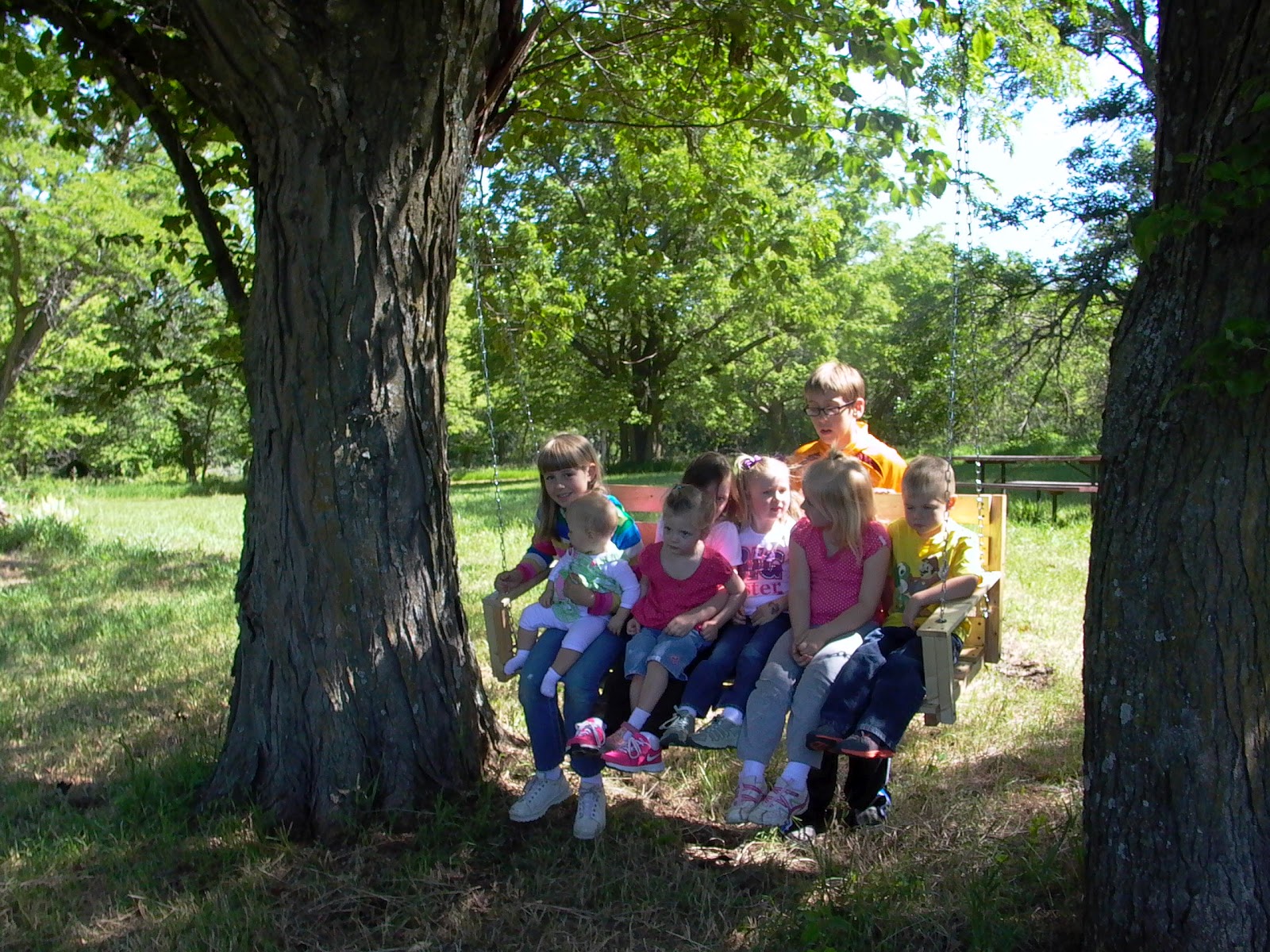
I love that in place of the old swing—maybe my grandma’s favorite place in the whole world—there was a new swing, hand-built by the son of the man who takes care of this place, in anticipation of our arrival.


I love that even though I was sure the perfect memento from the day would be a picture of the new swing standing empty, it was immediately and continuously full of great-grandchildren. Great grandchildren who smiled and talked and laughed and played.

Who scattered rose petals instead of ashes.


I love that sometimes in the hard moments one small beautiful thing will present itself and allow you to attach yourself to it so you can hold your heart steady.


I love that after the moment has passed you realize that you are in fact surrounded by relatives of that small beautiful thing—cousins and aunts and uncles and grandparents and great-grandchildren and many others, besides. That there is much to hold on to while you can.

That a life keeps flowing outward even when the person is no longer with you.


Subscribe to Dreamer by Email

Friday, December 30, 2011

Sandbakelser


I had no idea we had a secret recipe.

I enjoy baking very much, but it is one of the things that has fallen by the wayside over the past few years. Even Christmas baking has suffered, and this year was the worst. Holding tightly to my homeschooling/teaching violin/writing schedule until the week before Christmas and then immediately leaving town meant letting go of virtually all Christmas preparations.


Last week, though, while we stayed with my parents, I helped my dad make sandbakkels. He has made these cookies almost every year for as long as I can remember. Often he makes fudge, too—dense, sweet logs of it that have to be kept in the refrigerator wrapped in waxed paper. My mom makes jan hagels—Dutch Christmas cookies that we all love even though we aren’t Dutch. Other sweets have come and gone, but these three desserts are steady companions at my parents' table.

Sandbakkels are Norwegian cookies (many claim they are Swedish, but I have Wikipedia on my side.) The name translates as “sand tart,” the flavor and texture sort of a cross between a sugar cookie and shortbread. Scandinavians, I am convinced, know the secret to good cookies: you don’t need much more than flour, sugar, butter, and eggs. Also, you cannot skimp on butter, and you cannot use what Youngest calls “fake butter.” Of course, there’s also the presentation. Rosettes, krumkake, kringle—the Scandinavian cookies I grew up on were as much about their beauty as their flavor.


To make sandbakkels, the dough is pressed into special fluted tins and baked. After baking, each cookie must be carefully removed from its tin. This, to me, is the tricky part. According to my dad, we got the texture perfect this year—delicate and flaky—but only about half of them survived being removed from their tins. The survivors, though, are lovely, buttery cup-shaped cookies. The ones made in my dad’s tins remind me of paper cupcake liners, those made in my tins remind me of flowers. Although we do not fill ours, they are traditionally filled with fruit or preserves and whipped cream. The ultimate treat, according to my dad, is to use cloudberries, which are shaped like raspberries, but are yellowish-orange and slightly bitter. I think they sound like something out of a Scandinavian fairy tale.


My dad helped his mother make sandbakkels from a young age. She, too, taught music lessons in her living room, and made all the delicious Norwegian desserts my dad remembers from childhood Christmases only with help from her family. Her recipe for sandbakkels was special, different from the many other recipes my dad looked at over the years. Her grandmother taught her how to make them, and she had the recipe written down without any specific amount of flour indicated. Apparently flour changed so much from harvest to harvest at that time that cooks had to know by texture when they had the perfect amount. But she won a blue ribbon at the North Dakota State Fair for her sandbakkels when she was just ten years old, competing against grown women because there was no children’s division for that sort of thing.


Watching my dad work, I was struck by his slow, careful movements. Scraping butter off a spoon required the same attention as pressing dough into a mold, and all of it was an artistic undertaking. This is the man who taught me how to play violin, but that is by no means the only thing I received from him. There is a rhythm to this kind of work that we seem to share, and it is careful, loving. Our tempo for this kind of thing is decidedly andante.


When my dad was still a child, his mother figured out the exact measurement for the flour and sent her recipe in to Better Homes and Gardens. He does not remember what the contest was for, but she never heard back from them. The recipe became their property to do with as they wished.

My grandmother died when my dad was thirteen years old. Although I never knew her, I have always felt a deep connection to her. I have her name for my middle name. I discovered, during my senior year in high school when my favorite hour of the day was spent on a pottery wheel in ceramics class, that the beautiful handmade pots scattered throughout our house were her creations. When I took up knitting I learned that she, also, learned to knit as an adult, and gave all her friends mittens with elaborate colorwork for Christmas one year. Even my allergies, and the fact that all my life, every cold or flu-like illness I get wants to descend to my chest and linger there, connects me to her. She, however, suffered far more than I ever did, and died from a sudden, severe case of pneumonia during a flu outbreak.

My dad kept her recipe for sandbakkels, written on a slip of paper, for many years. Eventually it disappeared, he does not know when or how.

Years later, he found a recipe in a Better Homes and Gardens holiday cookbook that almost exactly matched his mother’s. Nestled among recipes for “Springerle” and “Berliner Kranser” is a recipe for “Sandbakelser” that may or may not be his mother’s, but is close enough to hers that we claim it as our own. There are things missing from it—small, secret details that my dad wants to keep within our family, anyway—but it is something tangible, an assurance. Sometimes the things which we think are lost are in fact, not.

Sunday, May 8, 2011

Today

I’m thinking today of my mom, how she still shares books with me, reads what I write, calls regularly. How becoming a grandmother seized her even more strongly than she thought it would.

I’m thinking today of her mom, who died Mother’s Day weekend last year. Who loved to sing and draw and swing and flirt and ride horses. Who was strong even as she lay dying.

I’m thinking today of her mom—my maternal great grandmother. Of how I remind my mom of her. The one who married a photographer and dreamed of being a writer, but was busy raising three young children in a time when laundry was all done by hand.

I’m thinking today of my other grandmother, the one I never knew. The one who died too young, before her sons were grown, but who I know through stories to be an artist, a musician, a queenly woman.

I’m thinking today of her mother—my father’s grandmother. Not only an organist but someone who was always creating, always doing. The one who was so tiny and strong that when she fell into a heating duct while cleaning she was able to hang there by her elbows until her husband got home from work and pulled her out.

All these women are a part of me somehow, and I am humbled by and thankful for that heritage.

Happy Mother’s Day to you.

Friday, April 15, 2011

Redbuds


The redbuds in our yard are about to bloom. Last year was the first year I was really aware of them, knew them as trees with a name. It was our first spring in a new house, and a happy surprise to discover that these small, slightly twisted silhouettes held so much latent grace. I love that about new places—discovering with each season all the treasures each one has to offer.

Last spring while the redbuds were blooming, my grandma was dying. It was precisely this weekend—the weekend of the Children’s Literature Festival at our local university, the weekend of our final symphony concert of the season, the weekend of some of my favorite things—that my sister called me early Sunday morning. “Grammy is giving up.” All weekend, knowing that she was in the hospital, I had considered this possibility. I lay in bed and cried for what was coming. Within a few hours we were driving to Lincoln. We had a reunion of sorts in the hospital; cousins, aunts, and uncles gathered around her bed while she acknowledged that yes, she knew it was possible to treat this, but she was ready to go.

We made more trips back and forth. All around us everything was coming to life. There were flowers in my grandma’s apartment and flowers outside her window. In the middle of everything we had time to say goodbye, time to sit with her, time to talk, time to sing, time to cry. Time was at once suspended and moving forward, and I can honestly say that there was beauty all around us and we saw it along with the hurt.

This is my favorite part of spring—when the buds have not fully opened and the greens are all new, when everything is about to burst but hasn’t yet. There was a spring a few years ago, in another city, when a cold snap hit just as everything was getting ready to open. We lived for what seemed like a week, maybe two, in a state of suspension, in the state of delicacy just before blooming. There have been springs I missed that moment entirely, but that year I got to revel in it. I took it as a personal gift, even though I knew it wasn’t about me at all.

This year I am watching spring and thinking of my grandma. Last year we lived in a state of suspension. This year everything seems to be moving on pace. I hope, though, that I am changed. I can live so myopically. It was so clear what was important, sitting with my grandma, her telling me that I was doing the important things--that I was surrounded by them, in fact. Hourly, though, I easily forget that I am in the middle of time, in the midst of loved ones. So I keep trying to stay awake to the reminders, keep trying to take hold of the moments when time is suspended, even as it marches on.

Tuesday, May 18, 2010

The Call

The Wind in the WillowsYou know how things just come together sometimes? I’ve been reading The Wind in the Willows to the kids for a while now, and we’ve been enjoying it thoroughly. This is my first time through it, and I’ve been surprised by the depth—I knew it was a classic, but somehow all I expected was cozy stories about animals. Good stories, but just nice and cozy. Silly me—I should have known it was a classic for a better reason than that.

We hit the following passage on a Friday afternoon a week and half ago. We were at the end of a get-through-it sort of a week, and I figured the best Language Arts lesson we could have at the end of a week like that was a good long read-aloud. So I read, and read, and read. And we got to “Wayfarers All”, the chapter about the Water Rat’s restlessness as other creatures were heading south for the winter and he was left behind, and it struck me deeply:


Restlessly the Rat wandered off once more, climbed the slope that rose gently from the north bank of the river, and lay looking out towards the great ring of Downs that barred his vision further southwards—his simple horizon hitherto, his Mountains of the Moon, his limit behind which lay nothing he had cared to see or to know. To-day, to him gazing south with a new-born need stirring in his heart, the clear sky over their long low outline seemed to pulsate with promise; to-day, the unseen was everything, the unknown the only real fact of life. On this side of the hills was now the real blank, on the other lay the crowded and coloured panorama that his inner eye was seeing so clearly. What seas lay beyond, green, leaping, and crested! What sun-bathed coasts, along which the white villas glittered against the olive woods! What quiet harbours, thronged with gallant shipping bound for purple islands of wine and spice, islands set low in languorous waters!
He rose and descended river-wards once more; then changed his mind and sought the side of the dusty lane. There, lying half-buried in the thick, cool under-hedge tangle that bordered it, he could muse on the metalled road and all the wondrous world that it led to; on all the wayfarers, too, that might have trodden it, and the fortunes and adventures they had gone to seek or found unseeking—out there, beyond—beyond!

I started a post later that afternoon, but before I could finish our computer was accidentally pulled off the table and the screen shattered, and I’ve been unable to access it until yesterday. Here’s what I was thinking that day:

Our family is getting a glimpse of two worlds right now. I don’t know how else to put it. We are going through our daily lives, busy with end-of-school-year activities, thinking about summer, doing dishes and laundry, fighting colds. At the same time, a loved one is dying. Each day this week our day-to-day, regular life has been interspersed with calls from my mom with updates on Gram’s physical and spiritual state. She is at peace. She smiles even in her sleep. She is in a physical state of decline. We are at peace; we rest in the faith that she is on her way to heaven, and that this is not a final goodbye but a long separation.

My grandma died that night. We miss her terribly, and are thankful for many good years and the chance to say goodbye before she passed. That time between worlds—well, it feels like a door has closed for now. And it may be a small thing, but I find I have a new friend in Kenneth Grahame, who wrote a book in 1908 that spoke into my life in 102 years later in a way that he probably never intended, but that I will probably never forget.

“To-day, the unseen was everything, the unknown the only real fact of life.”

Monday, May 3, 2010

If You've Seen One Peacock...

We went to the zoo one afternoon while we were visiting my grandma, giving her a chance to rest and giving my kids a chance to blow off steam. And while there were many wonderful things to see, I enjoyed the peacocks most of all. I’ve seen a few peacocks in my life, but have rarely seen them displaying their tail feathers. On this particular day, however, both the peacocks I saw were on full display, fans open wide, and turning slowly so everybody could see. The first peacock was the kind I usually think of, brilliant shades of blue, green and gold. The second peacock, which we found near the concession area, was pure white. I thought he was beautiful, stunning in the way that things are when your emotions are on overdrive. His lack of color stood out against everything else, and he struck me as other-worldly, forever tied to what was probably my last visit with my grandma.

I decided to take a few pictures to show her, and the peacock was kind enough to oblige me. But during our little photo shoot, I overheard the conversation of a family walking past, and now it, too, is forever joined with that extraordinary weekend:

“Hey, Mom, can we take a picture of that peacock?”

Mom: “No.”

“Why not?”

Dad: “Because if you’ve seen one peacock, you’ve seen them all.”

Now, I’ve given my kids plenty of short, ridiculous answers like that, so I don’t hold it against the dad. There’s no telling what preceded that conversation. But at the same time it struck me as an amazingly sad thing to say. Hopefully it was just a momentary, thoughtless answer. Because I can’t imagine going through life with that attitude, shut off from the wonder.

Earlier in the day, Gram and I had been talking about books, among other things. She has spent much of the last year reading. “You know,” she said, “you go out onto the street and there are all these people, and they all have stories. It’s amazing.”

You can be ready to leave this world and still see the wonder in it. I hope I don’t rush past too many peacocks.

Thursday, April 29, 2010

The Poem in my Pocket

Today is Poem in Your Pocket Day
The Swing
by Robert Louis Stevenson

How do you like to go up in a swing,
     Up in the air so blue?
Oh, I do think it the pleasantest thing
     Ever a child can do!


Up in the air and over the wall,
     Till I can see so wide,
Rivers and trees and cattle and all
     Over the countryside—


Till I look down on the garden green,
     Down on the roof so brown—
Up in the air I go flying again,
     Up in the air and down!

“You know that swing out in front?” I know the swing well; Gram and the kids and I sit on it every time we visit her. It’s the kind that is self-enclosed, two benches that face each other which you move by pushing on the floor with your feet. The neighbor kids had a smaller version on their swing set when I was a girl. “Well, I still swing on it,” Gram told me a few days ago, “I swing as high as I can. Some people like to just glide back and forth, but I go as high as I can on it.” I have no doubt this is the case, and that I love that about her.

My grandma is a spunky woman, to say the least. She is 97 and a half, and probably very close to passing from this world, but the idea of being on a swing still makes her eyes shine. It was only 3 or 4 years ago that she shocked me and my mom by leaping off a swing at a playground after swinging alongside my daughter, behaving as though there weren’t a 90-year span between their ages. She landed unscathed, and on both feet, but I remember thinking at the time that maybe it’s worth jumping off a swing just one more time, even if you do get hurt.

All three of my children went through a stage where if you asked them how much of something they wanted, like a snack, or a treat, their answer was “Too much.” Come to think of it, that’s still my favorite amount of good stuff, too. And I’m guessing that my grandma never let go of that childlike way of embracing the good things in life. I like to imagine that she’s taken that swing in front of the senior center so high the feet were in danger of lifting out of the ground. That whoever is in charge of upkeep has scratched his head in wonder that he has to keep shoving the poles deeper into the ground every month or so.

I saw Gram get on a swing every time she had the chance, and listened to her recite Stevenson with reverent joy just about every time. Her voice is forever joined in my mind with the rhythm of the poem and the motion of a swing. Especially that moment when you swing too high and the chains slacken a bit and your stomach drops, right before you get pulled backward and down, only to go flying up in the air again. I think it’s time to head for the playground and continue the legacy—swing as high as I can.  Maybe even too high.

Wednesday, April 21, 2010

Love, Tears, and Laughter

Posting may be sporadic here for a while. My grandmother, 97 years old and as strong a woman as ever, has decided she’s gotten as old as she needs to get. An illness took her to the hospital last week, and she decided over the weekend that she wanted her I.V. out. A large portion of her family gathered to be with her on Monday, and I have to say, it was very much like a party. She was weak, but completely herself, and loving seeing everybody. What a blessing to get to honor her and celebrate her life while she is still living! I am home for a few days right now, but am going back on Friday, and don’t know what to expect from there, beyond love, tears, and laughter.

Tuesday, March 16, 2010

My Symphony

My grandfather gave my grandmother a copy of this quote not long before her death because he thought it described her well. I never knew her—she died before my father was grown, but I have always hoped I carried part of her with me through life. I am told she held these ideals closely, and even though this is a pretty well-known quote I thought I’d pass it along. They are good words to aspire to:


To live content with small means, to seek elegance rather than luxury, and refinement rather than fashion; to be worthy, not respectable; wealthy, not rich; to study hard, think quietly, talk gently, act frankly; to listen to stars and birds—to babes and sages, with open heart; to bear all cheerfully, do all bravely, await occasion, hurry never; in a word, to let the spiritual, unbidden and unconscious grow up through the common. This is to be my symphony.
William Henry Channing