Showing posts with label teachers. Show all posts

Tuesday, January 29, 2019

How to Unlock Your Teacher's Super Powers

Yes, your teacher has super powers. They are hidden, and you the student hold the key.

I am thrilled to have this article included in the latest edition of the American Suzuki Journal, and they have seen fit to put it up on their website this week. It is a special message for students and their parents, and absolutely just as much for those outside the Suzuki world as for those within.

If you want, you can tag your favorite superhero teacher on the Suzuki Association of the Americas Facebook page, here.


Subscribe to Dreamer by Email

Thursday, July 7, 2016

"That Hard Passage," ASJ

Last fall my friend Sarah asked me to share what I had carried with me into adulthood from my childhood Suzuki training. There are many things--part of what I love about teaching is that it keeps showing me more about not only my own musical training, but my whole upbringing, deeply informed as it was by Shinichi Suzuki's teachings and philosophies. But this answer, what I am starting to think of as the discipline of beauty, is the one closest to my heart. I think it transcends the Suzuki philosophy, actually, to all of music and art, but this is where I encountered it in my own life. I am thankful to the American Suzuki Journal for giving me the chance to share my essay, "That Hard Passage," with a larger audience, both in their most recent volume (44.3) and here on their website.


Subscribe to Dreamer by Email

Saturday, May 7, 2016

(This is not about violin--


but most of what we are doing during lessons and classes is not actually about violin.)

Recently one of my 3rd graders caught a glimpse of the top of my head while I was tuning her violin.

"Your hair is turning white!"

"Yes, it is! That's okay. I actually kind of like it."

She nodded. 

"I guess I'm getting older and changing, just like you are." It was really only as I said these words that I realized how true they were. Had I known this, before it came up? 

I cannot tell you how often something like this happens. It seems like it would be enough, just learning a skill like how to play an instrument. But there is always so much more going on. The focus is violin. We work pretty hard on that. But what it is about lies always just below the surface of what we do every day, and sometimes rises above, glimmering. I love these moments more than words can say.


Subscribe to Dreamer by Email

Sunday, August 30, 2015

This is For You


Not long ago, she offered me a drink she had made: bright green, unnatural, an offering of love and self.

If you know the story of Persephone, or if you know much about fairies, you are familiar with the dangers of eating the food offered to you by certain beings. It binds you to them, makes you a captive in their land. And childhood is certainly a foreign land to those of us who have been away. Adults develop a strange accent. I have found it good to live close to the borders, to make excursions in, to stay fluent in the old language. 

Spend time with them, and they will offer you things. Of course it’s risky, but love is. 

I drank the whole thing.


Subscribe to Dreamer by Email

Monday, March 23, 2015

Found, Day 34


Middle brought me the tiniest purple flower today while I was tuning violins for the Violin Project. She found it while walking over from the middle school and presented it to me with reverence. I set it down on a shelf nearby where it found good company next to two handmade ceramic figures—a cat with a green collar and a father penguin with a baby on his feet—that needed a safe place to rest before finishing their trek home from school.

Because of the children in my life I have become a Sharer of Treasures. This is a position of honor, and nobody asked if it is deserved. I just one day found myself here. But in this place of honor I hear about the best (funniest, grossest) parts of books, I see the proudest-of pages of homework and artwork and projects. I peruse and contemplate untold riches: new shoes, plastic cupcake rings, agates, stories about baby brothers and sisters, knock-knock jokes. I know these things differently than I did when I was a child. Yes, I see them with adult eyes. Somehow, though, this second glimpse into childhood balances things out, and I see their value increase, not decrease. I see them as they are.


Subscribe to Dreamer by Email

Friday, February 13, 2015

What You End Up With


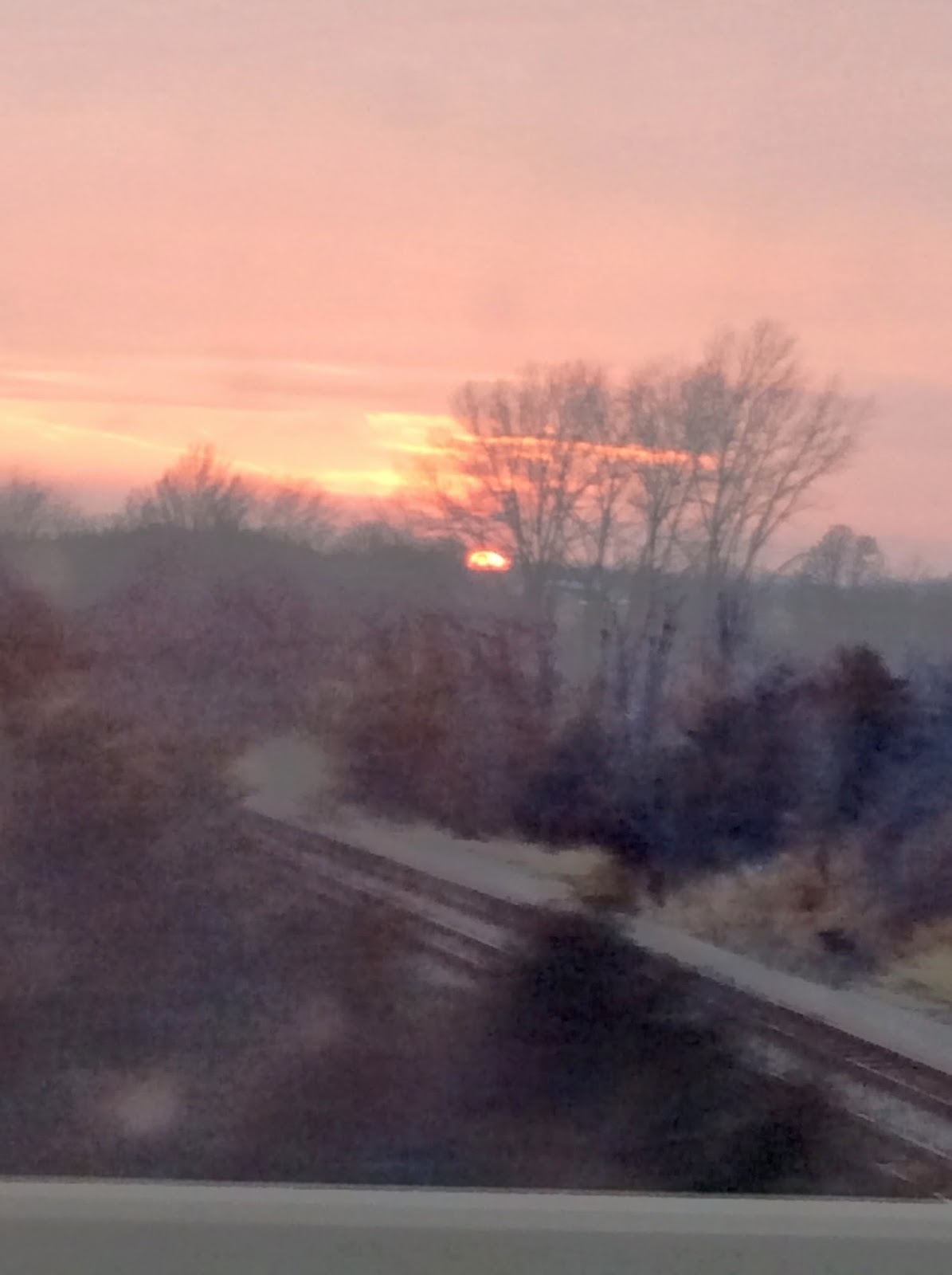
I have next to no expertise with a camera. I am in awe of what people who have skill can do with their cameras, and I’m frequently frustrated by what I can’t do. But I’m also fascinated by what I can capture, even in my ignorance and lack of skill. In the car with Husband a few nights ago, appreciating again the colors of winter in my adopted state, and setting sun, and gentle rolls of fields, I took as many pictures as I could. I liked so much of what I ended up with, even while I didn’t capture exactly what I saw out the passenger seat window. Expectations aside, I ended up with something beautiful. I was still participating in some form of seeing.

That play of expectations and my response and what I end up with in the end—it can make me crazy, but it also makes life something of a holy kaleidoscope. And I like that. A lot.

It struck me a few months ago, while walking an unruly bunch of young violinists back from the bathroom and wondering at the crazy swinging we do every day between off-the-wall-tired and brilliant-short jags of learning: what if one of our primary responsibilities while we wade through this life—this chaos—is to dip our hands into it as it flows past and make something of it? Sometimes it requires great skill to form something (smooth, perfect, compact maybe, or maybe towering and grand.) Sometimes all that is needed is to reach into the torrent and hold up, shining and raw, what I get hold of. Either way I am on a treasure hunt. Either way the best thing next to the find is showing it to you.


Subscribe to Dreamer by Email

Wednesday, January 21, 2015

Medley, 1/21/15


So my writing recently has focused on things other than for this blog. It’s a shift I’m enjoying, but being a little out of the blog habit makes emerging from my shell that much more uncomfortable. Today, though, I thought I’d share a few of the things that have been on my mind:

1. This article about phone use and boredom. It came out more than a week ago but I keep thinking about it. This idea that allowing the mind to wander is great for creativity is not new to me, and I have been working to make/keep space for that in my life. (My new battle cry, in fact, may be “Make space!”—not just for creativity but for life in general.) The idea that my smartphone gets in the way of or fills that space makes sense. I do not think I will download an app to help me with this problem, but it is something I’m attending to in my own life. The thing that actually fascinates me the most about this article, though, is the idea of boredom. I’ve maybe always equated boredom with restlessness, for example being in a situation that I had to pay attention to something I wasn’t interested in. The state I’m in when my mind wanders—I don’t have a lot of trouble getting there, and I enjoy it a lot. I’m not sure I’ve ever considered that boredom. What about you?

2. One of the books I’ve been burying myself in recently is The Gift: Poems byHafiz, translated by Daniel Ladinsky, entirely because of two poems I keep running across/thinking about: “With That Moon Language,” and “Dropping Keys.” I'm moving slowly through this book; I keep finding new favorites. I keep wanting to write more poems myself, and at the same time I feel tempted to quit. Maybe everything good has already been said.

2. And then this, a TED talk by Cristina Domenech, “Poetry that frees the soul,” about teaching poetry in an Argentinian prison: “And in that seventh circle of hell, our very own, beloved circle, they learned that they could make the walls invisible, that they could make the windows yell, and that we could hide inside the shadows.” Please make time for about 12 ½ minutes and subtitles. 


Subscribe to Dreamer by Email

Tuesday, January 13, 2015

Questions, Answers


Last week I wrote some, practiced some, organized some. I did lots of normal everyday stuff and also cleaned my office (definitely not normal-everyday.) The whole week, frost flowers climbed across my office window, advancing and receding without my really noticing the movement. Just every once in a while—hey, look at that! and later—gone.

Also last week, from A.Word.A.Day, this: There are years that ask questions and years that answer. –Zora Neale Hurston

I’m so glad that’s true.

I had been suspecting it, wondering on some level. Because what a relief. If entire years can ask and answer questions then that allows for time—long stretches of itand all the other things that move slowly and profoundly but only while you aren’t looking. Like the frost on my window.

*     *     *

Friday afternoon, as we worked our way through a bitter windy parking lot after violin, Oldest and Middle expounded on the future of technology. The things they talked about teetered on the brink of science fiction: information uploaded directly into our brains, easy learning, instant knowledge. I had to ask: So is being able to carry or transfer information the same as knowing something? I think they thought I was trying to be argumentative, but I wasn’t. I spend hours a day trying to move people from understanding, to ability, to something that is a deep abiding part of their being. Besides effort and process, the thing that seems to matter the most in this progression is time.

*     *     *

Whole years of questions = whole years of discomfort, true. But the softness of not-knowing is there, too. Have you ever run into the hard brick wall of someone else’s Knowing? I think I prefer softness. That slow slow motion and growth. Because it must be here in the question years that compassion grows, and humility, and humanity.

The years that answer—they are like breathing pure oxygen. Peaceful, whole. Welcome. And yet they probably hold as much potential for danger as the question years. A person could get stuck there. The questions and answers need each other desperately, and as much as I hate to admit it I need them both.

These are things I maybe have not wanted to accept: the necessity of the question years, the long periods of time that answers and understanding require, the waiting. But the idea of slow things, of softness and knowing and Time, of a cycle of questions and answers that does not ever have to tire out—there are promises there. They make me want to promise to keep watch.


Frost flowers creep
across the window—
seen, not seen.


Subscribe to Dreamer by Email

Monday, December 15, 2014

Light: 12/15/14


Every day I see this. During arrival/tuning/snack time, especially—they are experimenting, exploring, asking each other questions, teaching each other stuff. Every day I see this fire for learning igniting around the music room. Yes, they are tired and distracted after a long day at school. But still. I get to work with that fire.

Maybe one of these days when someone asks me what I do, instead of saying “I’m a violin teacher” I will tell the whole truth: “I am a violin teacher, a witness-er of miracles, a problem-solver, a counselor, a herder of squirrels, a maker of music, a fanner of flames.”


Subscribe to Dreamer by Email

Friday, November 21, 2014

Thankful, 2014: A Chance to Watch

1. At my students’ fall recital, sitting finally—momentarily—watching and listening. These milestones—you hit them whether you feel ready or not, whether you are sick or healthy, regardless of what else is happening in your life. We work for mastery. We work to capture the spirit of the piece. But what is on display in front of us is always deeper than those things, broader than the performance.

 So many dramas at play, and most of it hidden.

My pride in my students, and the fact that I am on the edge of my seat for each person who walks to the front of the church and bows and plays and bows again has everything to do with knowing them. Their stories, their struggles, their triumphs. Working with them I have gotten glimpses of these things, and I promise you even Twinkle is never the same piece twice.


2. Sitting with the pit band on the opening night of Fiddler on the Roof. Technically my first high school musical, if you don’t count the All-City Opera production of “The Magic Flute” I played in ninth grade. It is an odd and beautiful experience at 42, and I can’t get enough of watching. 

I am here to play, but my heart is with Oldest, on stage. Stage fright for the people you love is almost worse than stage fright for yourself, and it has nothing to do with your confidence in your loved ones or their abilities. As we start playing “To Life” the only thing tempering the adrenaline is the fact that I am used to playing despite it. Besides, I have to focus on what I am doing. 

And then it is his solo, and he is standing on a bench, hand raised in blessing—hand with new angles, and handsome—nailing it:

Za vasle zdorovie
Heaven bless you both, Na zdrovie
To your health, and may we live together in peace!

I get to watch, and I get to be part of the music—his music. My pride in him, the fact that I am on the edge of my seat—you know what that is. I have been watching him since what must be the beginning of time, and the story is rich and complex and I know I will never grasp all of it.

But I get to watch.


Subscribe to Dreamer by Email

Sunday, November 2, 2014

Violins!

Wednesday I brought the new violins to class, and the rest of the week was an even more pronounced mix of our usual brilliant moments and chaos. The anticipation building up to this week has been thick, and now that it has been released—oh. 

Wednesday pretty much everybody forgot about snack. They forgot to be squirrelly when we went to the bathroom. They were focused only on the violins, and for a certain amount of class I gave in to the noise and the spirit of discovery and watched them explore. My seasoned second year students helped the first year students, showing them how to put their shoulder rests on and how to tighten the bow, and then everyone just tried stuff. It was beautiful and loud, and I wish all of you could have witnessed it. The pictures, I think, tell the story well:


Subscribe to Dreamer by Email

Monday, July 7, 2014

Sideways


Some stars disappear when you look at them straight on. Pale glints in your peripheral vision when you look up, they slide into blackness when you turn your eyes toward them. The issue is in our eyes: the cones concentrated in the central part of the cornea—the part we use when we look at something head-on—do not pick up the dim light that the rods around the edges of the cornea do. Regardless of the constancy of what we're looking at, we are stuck with what our eyes can see: stars-like-phantoms. They must be approached sideways, and gently.

It’s not just stars, though.

It’s something I’ve been thinking about for months—the sideways-ness of things.

It is ever-present in teaching, especially so for me this past year, working with a small group of children every day. Threaded all through the process of learning violin are other things: how we treat one another, how we handle problems, how we respond to frustration. How we show love and respect and kindness. How we create and respond to beauty. How we learn to discipline our fingers, our ears, our mouths, our minds. How we simply learn one another and build relationships—complicated, real, and gritty.

This is why I find it hard to write about teaching. It is personal, ongoing, complex. It is also universal. The fact that I can focus on one thing—learning to play violin—is very helpful, because I can rule out Everything Else. Except I draw on Everything Else to do it—faith, psychology, physics, storytelling, eating Dorito’s—everything. And then of course it turns out that learning violin touches everything else. Try to nail the whole thing down, narrow it, look at it too directly, and you start to lose sight of certain things. Sometimes you have no choice but to approach sideways, gently.

It’s fair, I think, to start wondering which is the true artthe direct work or the sideways, the music or the people working on the music? It’s both things at once of course, but it’s worth considering what you might see when you shift your focus, and what is most important to you to see in the end. 


Subscribe to Dreamer by Email

Friday, May 2, 2014

In Concert

At our last class before the concert, I made them a promise:

No matter how calm I look when we’re up there on stage, I will be nervous too. I’ve been doing this almost my whole life, and I still get nervous. But we’ll all be there helping each other, and it’s going to be great.

I did not tell them that I’ve been nervous for months.

My violin students—Violin Project and private students—were invited to play with the local community string orchestra back in January. I looked at the music and said yes, I think we can make that work, knowing it would be a stretch. Knowing this was new territory for all of us. We had time, and we got to work right away. I believed that together we could rise to the occasion.

But I was nervous. Afraid of letting people (my students, their families, the conductor, the orchestra) down. 

One month before the concert, I was quite nervous. We had been working hard, yes. But we had a lot of leaps to make.  The second violin part didn’t always make sense to a group of kids who had always played melody, and the form was more complex than they had ever encountered. This is not such a big deal if you can just follow what’s on the page in front of you, but to a pre-reader it matters. Memorizing something you would probably never hum to yourself is not a simple task.

The third violinists had their part down quickly, but they had to be able to hold their own rhythmically, and again—not easy. Not playing on down beats when everybody else is playing, not being swayed by the four other parts around you but listening to and sticking with your own part: that is sophisticated stuff for a beginner.

The first violinists—they had a lot of notes to learn. And life is busy, and so many important things want to get in the way. I knew they could do it, but I was concerned about their confidence.

The week of the concert, however, things came together. I started to relax. I got excited. I was thankful for how good everything sounded. 

Then the day of the concert: I taught my regular lessons, picked up my kids at their grandparents’ house. We ate half our dinner in the car on the way home. At home with a few minutes’ turn-around time everybody had a job: Oldest, help set the table, Middle, change clothes, Youngest, go back out to the car and bring your backpack and jacket inside.

A few minutes later, crying. Youngest back inside with her hand to her head. Blood. And then she moved her hand away and I yelled, I couldn’t help it, because Oh-God-she’s-really-hurt.

Somehow what felt like one hundred decisions were made in an instant. Call Husband. Call Friend who will be at the concert. Do not let on to Youngest that she needs stitches until you absolutely have to if you want her to stay calm. You do not have to be at the concert. Your students can do this without you. Somehow I got Middle and Oldest to the concert location along with the stack of violins I had brought home with me “to make sure they all make it safely to the concert tonight.” Somehow I drove to Urgent Care answering Youngest’s questions as calmly as I could, even though every few seconds I had to clench the steering wheel hard. The image of her wound, my bleeding hurt child, flashed fresh in my mind over and over. Over and over I glanced at her face—pale, eyes half-shut—in the rearview mirror. Clench. Release. Clench. Release.

Clench.

Somehow everything worked out.

At Urgent Care: help. The nurse’s eyes looking at me over Youngest’s head after peeking under the gauze, the whole wordless conversation that passed between us. Oh, Honey. Yes. She needs stitches. I knew right away. Oh this girl, she fell really hard. She did, didn’t she? Husband arriving sooner than seemed possible. Youngest, scared and brave, fighting the stitches, still managing to be all at once sassy and funny with the nurses. Her confession to me with deep serious eyes: “I thought maybe I just wouldn’t tell you I fell. But then I thought maybe I should.” Her forehead mended, bandaged. Her arm sore, but not broken.

All the fear and worry that went into this concert—

They moved everything around on the program, and announced from the stage that the orchestra would just keep playing until I arrived to lead my students in their part of the program. Husband took Youngest for ice cream. I arrived at the church where we were playing and my students, a good number of them up past their bedtime at this point, were sitting in their designated seats, listening to the concert. Everybody behaving like angels, as far as I could see. Questioning looks. "She's okay," I told them. "She's going to be okay." We got up and played and I had moved far beyond nervous to shaken and dazed, but even so I could tell how well everything went. 

I am so thankful for all these people—family, students, friends. We were there for each other. I made it there for them. And they were there for me. For Youngest. For each other.

There is this thankfulness, too: I do not understand how Calm can be there in the middle of Fear and Worry, but it was—the whole time. I felt it there the same way I have felt it each time the world threatens to unravel, like the skin that holds my body together when everything beneath it feels shattered. Like that place deep withinat the center, maybe, of my heartthat remains solid and still when everything else is whirling.

And finally there is this, the deepest thankfulness: The day of this concert, there wasn’t room for much more. The day was tightly-scheduled, and there wasn’t room for more than just getting to the concert and playing it, everybody doing their best. I knew it would be great, and enough. And I almost always have a plan like that. The thing is, even when I think it’s a big, grand, wide-open plan that stretches me it ends up being a tight little thing. So when a Hand reaches down and breaks the whole thing wide open, I am shaken, and thankful. Because for a moment I see it all—larger, wider, and more beautiful than I thought it could be. Or than I would have allowed.

Release.


Subscribe to Dreamer by Email

Thursday, February 6, 2014

Inhale, exhale. Tear apart, rebuild.


Snow Day, take three.

I love the virgin windswept stuff as much as I love the clumpy boot-tracks through it, the small horse sculpture on our front porch, the snow cave in the back yard just off the driveway. I am claiming it all as vacation. Yes there have been plenty of arguments, children wishing they had been born an only child and maybe even wishing they had been born without-parents, parents who feel like there is constantly someone wanting something from three rooms away. But also there have been three mornings of sleeping in, three days of reading, movies, elaborate play scenes in the basement, three days of making stuff in all sorts of ways. 

I love that sometimes everything else has to stop for the weather, no matter what was planned. It's so much more fun than when everything stops for illness. To be honest, the weather we've been having here really just qualifies as normal "winter" in my mind, but I live in a place that doesn't quite have the infrastructure for dealing with it. And so normal life stops for a while.

I don't know what it is in me that feels a little giddy when the weather overpowers everyday-normal, but it hasn't disappeared yet, and I hope it never does.

I have been making things. And planning and thinking and puzzling over things (the kind of planning and thinking and puzzling I love.) Writing is a necessity these days, a kind of breathing. So too, though, is using my hands. Making something touchable, hold-able, outside-of-my-head is a different kind of breathing, and I've developed a whole new appreciation in the last few months for good strong breathing. Inhale, exhale. Take in, release. Internalize, create.

I've been thinking about the pomegranate that sat on the kitchen counter forever while my kids asked every day if we were going to have it for dinner. Because, welltime. And laziness. Finally, though, I got myself to coax the seeds from the peel and membrane wrapped tightly around them.

Like always, they were worth the trouble. 


I've been thinking, too, about how much of creating something actually requires a taking-apart. 

How art requires sketching and re-sketching and erasing and setting aside (throwing away? burning?) all the versions that didn't work. 

How many tantrums I had as a child because I didn't understand this, or, once I understood, didn't see how it was at all fair. 

How learning a new piece of music requires tearing it apart and putting it back together bit-by-bit, only to tear it apart and rebuild again. 

How uncomfortable and distasteful a process this can be and how a large part of teaching violin is helping students get past that, helping them to see all the rewards of putting in that kind of work.

How lifeif you want it to truly be a living, breathing thingif you accept your calling to make it a work of artis like that, tooa continual creation, a continual breaking-apart and re-shaping. 

How I know that and embrace it and fight it all at once. How I have to keep discovering it, even though I already know.

How being willing to participate in the whole messy process is a daily act of faith, and how that, too, is part of the Art.

Happy Blue-sky-bitter-cold Snowy Winter Day, friends.


Subscribe to Dreamer by Email

Saturday, January 11, 2014

Heat Signature


“Mom, look!”

Oldest had a projector set up in the dining room, shining across the table onto the drawn window shades. He had lit candles for dinner, a new small joy he’s brought into our lives recently, and their shadow—

“Look at the flames!”

“I know. That’s a heat signature. I learned about it on Doctor Who.” He started describing the episode.

I looked it up, and I’m not sure that’s exactly what we saw. However, the way my mind works, that’s okay. I learned something true.

First, the candles—their shadow showed something different. We could see their heat rising, rippling into the air. We saw how the flame took up more space—different space—as a shadow than it did as a flame. In your mind you can put flame and shadow together but you still don’t have the whole story.

Second—the idea of heat having a signature. Something that can be left behind, that identifies it's source, even. And of course, the physical side is only the beginning of it.

*     *     *

I’ve been thinking about what people leave behind. The better and longer you have known someone the more complex their signature. But a single sentence or look or gesture, left even by people who are maybe just passing through, can carve a signature deep into the soul, as well. 

“I always used to watch your thighs jiggle in dance class.”

“We! Hate! You!”

“When I had young children I did not bring them to the grocery store.”

The once-overs that said, “What are you doing here?” and “I just wrote you off.”

“He thinks you do drugs. You’re always staring off into space.”

“Well we decided we were going to let God decide how many children we have.”

“Well. You should try harder.

But also:

“You said our relationship could be about more than just joking around and you were right.”

“If you play as beautifully as you look I would love to hear you someday.” (This is especially powerful spoken by a famous violin teacher to a 13 year-old who does not feel beautiful.)

“You’re right. I made assumptions about who you were, and I shouldn’t have.”

You matter, too.”

“We’re so proud of you.”

“You were scared? Why didn’t you tell me? I thought you were just really, really brave!”

“I feel like I can talk to you about this.”

*     *     *

It strikes me that we don’t always have control over the signature, what we leave or what we carry with us. That whether it is good or bad or confusing, it continues to burn. That we can’t be certain what kind of trail we’ve left behind us.

It also strikes me that the signatures that burn warmest come mostly from people who are still a part of my life. That my handwritten signature looks the way it does partly because of decisions I made about how I wanted it to look. That I've seen a few small strokes change the entire picture, and that a true artist is always looking for ways to improve her craft.

And if you think that you somehow don’t matter, that you are not constantly touching others, you simply have no idea.


Subscribe to Dreamer by Email

Thursday, October 10, 2013

8


Eight violins ready to meet their students. Don't they look magical?

Today is Day 38 of The Violin Project at Kirksville Primary School, and the first day the students will hold real violins. To say everybody is excited would be a huge understatement. They've been working hard learning to hold "box" violins and dowel-rod bows, learning rhythms, singing, marching, and yes, we have even drilled "standing still" and "not talking." They seem to especially love playing "Fix the Teacher's Bow Hold."

I've been teaching for a number of years, but the fact that children learn things always, always feels like a miracle to me. Not because I don't believe they are capable of amazing things, but because being witness to amazing things unfolding in front of you is no small thing.

Best kind of magic there is, I think. It is not an easy job. But I love that I get to do this.


Subscribe to Dreamer by Email

Thursday, September 5, 2013

Treble Clef

 
When I introduce the term, somebody invariably hears me say “trouble clef.”
 
“I want a purple one of those,” one girl told me recently, after hearing me tell another student what that curly thing was called. “Wanna know why? Because I’m trouble!” I peeled off a sparkly purple sticker and placed it on her forehead, a reward for a completely silent last six minutes of class that day. The way she said it made me think she’s been told that only in the most endearing of ways.
 
I always try explaining that it’s treble, but students don’t always hear the difference. They don’t have a lot of context for treble.
 
Clefs are all about context, really. Sitting on the far left of the music staff, they tell you which note names are assigned to each line and space. If all instruments and voices shared a common clef most of them would find their parts written well above or below the staff. Which is difficult to read. So each clef designates a certain set of note names—treble clef, sometimes known as G-clef (its swirls lock down g on the staff,) accommodates the higher pitches.
 
The idea that pitches aren’t necessarily fixed is difficult. I, for one, live as though they are. Violinists don’t spend a lot of time reading in other clefs. When I look at a note, I hear a particular pitch in my head. Sound and physical location are linked in a way that is hard to break. Learning to read bass clef when I started piano lessons in 5th grade was like learning a new language. I’m fluent now, but it still doesn’t feel like my native tongue.
 
Besides, a violinist can get by, living as though this were a world of fixed notes, thankful she doesn’t play some other instrument that has to deal with relativity and perspective a little more up-front.
 
And isn’t it easy, living that way? Thinking you know exactly what fits where? Believing everybody else reads off the same staff?
 
I say treble clef, and somebody in the room hears trouble clef, and it always makes me smile.
 
As tempting as it is to behave as if everything is fixed and sure, though, I am just as tempted to be overwhelmed by the complicated definition, the deeper answer, the mystery of it all. In music, in life, wherever. I see generosity in a treble clef. Part question mark, part ampersand: Treble voice, in the vast world of sound you are here. This is your starting point. Play—make it music.
 
A starting point is a wonderful place to start, wherever you are, whatever the notes.


Subscribe to Dreamer by Email

Wednesday, August 21, 2013

Listen (Play It the Way You Would Sing It)


Family Camp a few weeks ago: we were singing, and Youngest crawled into my lap. When she pressed her head against my chest I must have stopped singing, wondering if she was okay.

She sat up slightly. “Keep singing.” Then she pressed her ear against my chest. That’s when I realized she was listening, feeling the vibrations of my voice.

I asked her about it later. “Were you listening to me sing?”

“Yeah. I could kind of hear you differently. Like, ‘Doooooooooooooh’” she held her hands out by either side of her head and shook them slightly to illustrate.

    *     *     *

I remember as a child calling my mom for something; she was upstairs, I was downstairs. And once while I called out, “Mo-ommm!” my lips formed a spit bubble, and the word sounded different. Soon I was trying to make a bubble every time I called “Mom!” and then I tried the word with my hands over my ears, then with my fingers stuck in my ears, then one-eared, then ears rapidly covered and uncovered. I don’t remember when my mom showed up to see what was the matter. By the time she got there I can’t imagine I knew what I’d wanted. I was too busy playing with sound, listening to my voice in all its permutations.

I wonder, now, how many times that happened.

    *     *     *

The summer between my junior and senior year of college I attended a wonderful music festival in the mountains of Colorado. It was a fabulous opportunity—9 weeks of intense orchestra playing, two programs a week of important repertoire, much of which I had never before played. What I kept to myself while I was there was that I was there as an alternate. Second (or maybe 3rd?) choice, and I didn’t want anybody else to suspect that maybe I didn’t really belong there. I practiced a lot, but there’s only so much cramming you can do in 2 ½-3 days.

What helped me more than anything was learning a new way to listen.

Maybe a deeper way says it better. I don’t know how to describe it, exactly, except to say that I learned to tune in to the other instruments, and to the orchestra as a whole, in a way I never had before. I needed to do more than simply play my part at the same time as everybody else. Really participating meant a kind of listening that followed along with my peers. I had to anticipate, respond, join in.

*     *     *

Playing on automatic is frighteningly easy. Finger here, finger here, note, note, note. This-then-that. When I was a child and teachers were trying to get me to engage with the music, they most often told me to play it the way I would sing it, or to sing along with myself as I played.

It works.

Singing along with yourself in your head makes for playing that is engaged, aware, alive. It creates music that communicates and responds.

That’s something more than playing with the right timing, or being completely in tune.

And I’ve been thinking that this is something that extends into the rest of life. I think about basic interactions, and conversations, and relationships, and it’s true of them as well: hearing is good. Listening and understanding is even better. But listening in a way that is active and engaged, that follows the other person as if you were singing a duet together—anticipating where the other person is going and moving-with, but at the same time always ready, responsive, for the quick 180s and subtle inflections you never expected—that’s the kind of interaction or conversation or relationship you remember and crave and strive for.

What would that be like, living it the way you would sing it?

Some inspiration for you (Leontyne Price and Carlo Bergonzi, Aida, "O terra addio." 5 ½ minutes, but feels longer, in the best of ways.)


Subscribe to Dreamer by Email

Monday, August 19, 2013

First Day


The box violins are ready, the bows are ready. Everything is packed, waiting by the door. I’ve read, and imagined, and planned.
 
This afternoon seven children and I are embarking on something of an adventure. Am I ready? That’s a tough question. This is an experiment—part dream, part doing-what-I-know-how-to-do, part emulating what has worked really well for others. All mixed-up into what I guess is my own, new, thing.
 
I worry about messing it up, boring the kids, going too slow, going too fast, revealing what a _______ I am to everybody who hasn’t already figured it out, disappointing people who encouraged me, disappointing people who donated money, disappointing parents, students, myself. I worry I will run out of material, overwhelm everybody, talk too much, feel too shy, act too weird, lose my nerve, fall flat on my face.
 
And then I remember: this isn’t just my thing. It’s our thing—mine, my students’, my family’s, the school’s, the community’s. And together, with care and listening and work, we can make something good.
 
Life is art. I believe that more every day.

 
(The Violin Project is on Facebook. Come visit.)


Subscribe to Dreamer by Email