Showing posts with label education. Show all posts

Monday, January 13, 2020

Make it New: Mending at Rock & Sling


Happy Not-Quite-So-New-Year, friends! So 2019 was quite a year, and I have spent very little time with this blog. I have instead been up to my neck with various and assorted Things, some fabulous, some not-so. One of the best things is that last fall I went back to school for a master's degree in English. Do I dare say I've resolved to post more here in 2020? For today, here is a link to my new post over at Rock & Sling: Make it New: Mending.


Subscribe to Dreamer by Email

Tuesday, January 29, 2019

How to Unlock Your Teacher's Super Powers

Yes, your teacher has super powers. They are hidden, and you the student hold the key.

I am thrilled to have this article included in the latest edition of the American Suzuki Journal, and they have seen fit to put it up on their website this week. It is a special message for students and their parents, and absolutely just as much for those outside the Suzuki world as for those within.

If you want, you can tag your favorite superhero teacher on the Suzuki Association of the Americas Facebook page, here.


Subscribe to Dreamer by Email

Friday, August 31, 2018

Artist Series at Rock & Sling

Thank you to Rock & Sling for the opportunity to share one of the books that is inspiring me right now. I haven't read The Wide-Awake Princess to my kids in years, but it is still speaking to me. Now more than ever. You can read the whole blog post here.


Subscribe to Dreamer by Email

Monday, August 7, 2017

What I Did This Summer


So I've been playing with paper for a long time. And long ago when I went off to college I thought I would have time to study both art and music seriously. When it became clear that I had to focus on one or the other, I told myself I would take art classes again someday, maybe after I got my big orchestra job. And life went differently than that. That's okay, though, because hovering on the side of my writing all this time has been this desire to extend words and thought more and more into a physical realm. This summer I took several classes at the Minnesota Center for Book Arts and my head and heart are bursting. (It's a magical place, and I can't wait to go back again.) The pictures above are things I made in class--now I'm trying to find time for skill-building, and practice, and ways to bring some of the ideas in my head to life. I have so much to learn, and I'm so excited.


Subscribe to Dreamer by Email

Wednesday, March 22, 2017

From My Reading, 3/22/17


From Animal Farm, by George Orwell:

Meanwhile life was hard. The winter was as cold as the last one had been, and food was even shorter. Once again all rations were reduced, except those of the pigs and the dogs. A too rigid equality in rations, Squealer explained, would have been contrary to the principles of Animalism. In any case he had no difficulty in proving to the other animals that they were not in reality short of food, whatever the appearances might be. For the time being, certainly, it had been found necessary to make a readjustment of rations (Squealer always spoke of it as a "readjustment," never as a "reduction"), but in comparison with the days of Jones, the improvement was enormous. Reading out the figures in a shrill, rapid voice, he proved to them in detail that they had more oats, more hay, more turnips than they had had in Jones's day, that they worked shorter hours, that their drinking water was of better quality, that they lived longer, that a larger proportion of their young ones survived infancy, and that they had more straw in their stalls and suffered less from fleas. The animals believed every word of it. Truth to tell, Jones and all he stood for had almost faded out of their memories. They knew that life nowadays was harsh and bare, that they were often hungry and often cold, and that they were usually working when they were not asleep. But doubtless it had been worse in the old days. They were glad to believe so. Besides, in those days they had been slaves and now they were free, and that made all the difference, as Squealer did not fail to point out.

*     *     *

I grew up watching the 1954 animated version of this at school. I've lost track of how many times I saw it, but the messages and images are pretty deeply-ingrained: the cruelty of Mr. Jones, the animal uprising, the Seven Commandments of Animalism. Napoleon's takeover. Good and faithful Boxer working himself nearly to death before being carted off to be made into glue. I always understood the movie as a warning about what had happened in the Soviet Union, but underneath that there was always what I now see as the core message: a warning about what we humans are tempted to do with power. What history has shown we do. That is what haunts me now about this book--that and how the truth flickers and shifts in the hands of some. How easily the others lose track, and go along with what is happening. This isn't just the story of a faraway place, locked into one point in time, it is something that happens over and over in our world. How simple it might be to just lose track, go along.


Subscribe to Dreamer by Email

Wednesday, February 22, 2017

From My Reading, 2/22/17


I started, but never finished, reading George Orwell's 1984 in high school. Eventually I will get back to it, but I am glad now that I read this first. 


From Brave New World, by Aldous Huxley:

"But why is it prohibited?" asked the Savage. In the excitement of meeting a man who had read Shakespeare he had momentarily forgotten everything else. 

The Controller shrugged his shoulders. "Because it's old; that's the chief reason. We haven't any use for old things here."

"Even when they're beautiful?"

"Particularly when they're beautiful. Beauty's attractive, and we don't want people to be attracted by old things. We want them to like the new ones."

A little later in the conversation, the Controller explains why none of the new things written can be like "Othello":

"Because our world is not the same as Othello's world. You can't make flivvers without steel--and you can't make tragedies without social instability. The world's stable now. People are happy; they get what they want, and they never want what they can't get. They're well off; they're safe; they're never ill; they're not afraid of death; they're blissfully ignorant of passion and old age; they're plagued with no mothers or fathers; they've got no wives, or children, or lovers to feel strongly about; they're so conditioned that they practically can't help behaving as they ought to behave. And if anything should go wrong, there's soma. Which you go and chuck out of the window in the name of liberty, Mr. Savage. Liberty!" He laughed. "Expecting Deltas to know what liberty is! And now expecting them to understand Othello! My good boy!"

The Savage was silent for a little. "All the same," he insisted obstinately, "Othello's good, Othello's better than those feelies."

"Of course it is," the Controller agreed. "But that's the price we have to pay for stability. You've got to choose between happiness and what people used to call high art. We've sacrificed the high art. We have the feelies and the scent organ instead."

"But they don't mean anything." 

"They mean themselves; they mean a lot of agreeable sensations to the audience."

"But they're...they're told by an idiot."

"The Controller laughed. "You're not being very polite to your friend, Mr. Watson. One of our most distinguished Emotional Engineers..."

"But he's right," said Helmholtz gloomily. "Because it is idiotic. Writing when there's nothing to say..."

"Precisely. But that requires the most enormous ingenuity. You're making flivvers out of the absolute minimum of steel--works of art out of practically nothing but pure sensation."

The Savage shook his head. "It all seems to me quite horrible."

"Of course it does. Actual happiness always looks pretty squalid in comparison with the overcompensations for misery. And, of course, stability isn't nearly so spectacular as instability. And being contented has none of the glamour of a good fight against misfortune, none of the picturesqueness of a struggle with temptation, or a fatal overthrow by passion or doubt. Happiness is never grand."

*     *     *

More and more I find myself wondering what we are buying, and buying into. How normal it seems in this corner of the world to expect and demand comfort and ease. How natural it seems to be to allow oneself to behave and be treated as first and foremost a consumer. How often I hear people confusing education with job-training. Does it raise a fight in you, the way it does me?

*     *     *

My other offering today, something old and beautiful. Spent, I suppose. But look:


Subscribe to Dreamer by Email

Thursday, July 7, 2016

"That Hard Passage," ASJ

Last fall my friend Sarah asked me to share what I had carried with me into adulthood from my childhood Suzuki training. There are many things--part of what I love about teaching is that it keeps showing me more about not only my own musical training, but my whole upbringing, deeply informed as it was by Shinichi Suzuki's teachings and philosophies. But this answer, what I am starting to think of as the discipline of beauty, is the one closest to my heart. I think it transcends the Suzuki philosophy, actually, to all of music and art, but this is where I encountered it in my own life. I am thankful to the American Suzuki Journal for giving me the chance to share my essay, "That Hard Passage," with a larger audience, both in their most recent volume (44.3) and here on their website.


Subscribe to Dreamer by Email

Wednesday, May 4, 2016

Recently--Spring 2016


Music and dance and field trips and State Solo and Ensemble contest and recitals and concerts! And plans for the summer and plans for next year. It is hard to even think straight, this time of year, but somehow we always make it to summer. In between, especially as the kids get older, are conversations about music and art and justice and politics and kindness. Oldest shares what he is listening to. Middle, even if she is sleeping over at a friend's house and her phone is dead, will make sure I know the moon is rising outside, full and magical. Youngest shares her art and her passion and her compassion. Husband brings home mystery snails and we delight in them, some of us maybe wishing we could move through the world the way they do. And there are small treasures to find outside as the world warms and greens: seeds and sprouts, fireflies, the sound of frogs, the scent of lilacs and honeysuckle.


Friday, February 13, 2015

What You End Up With


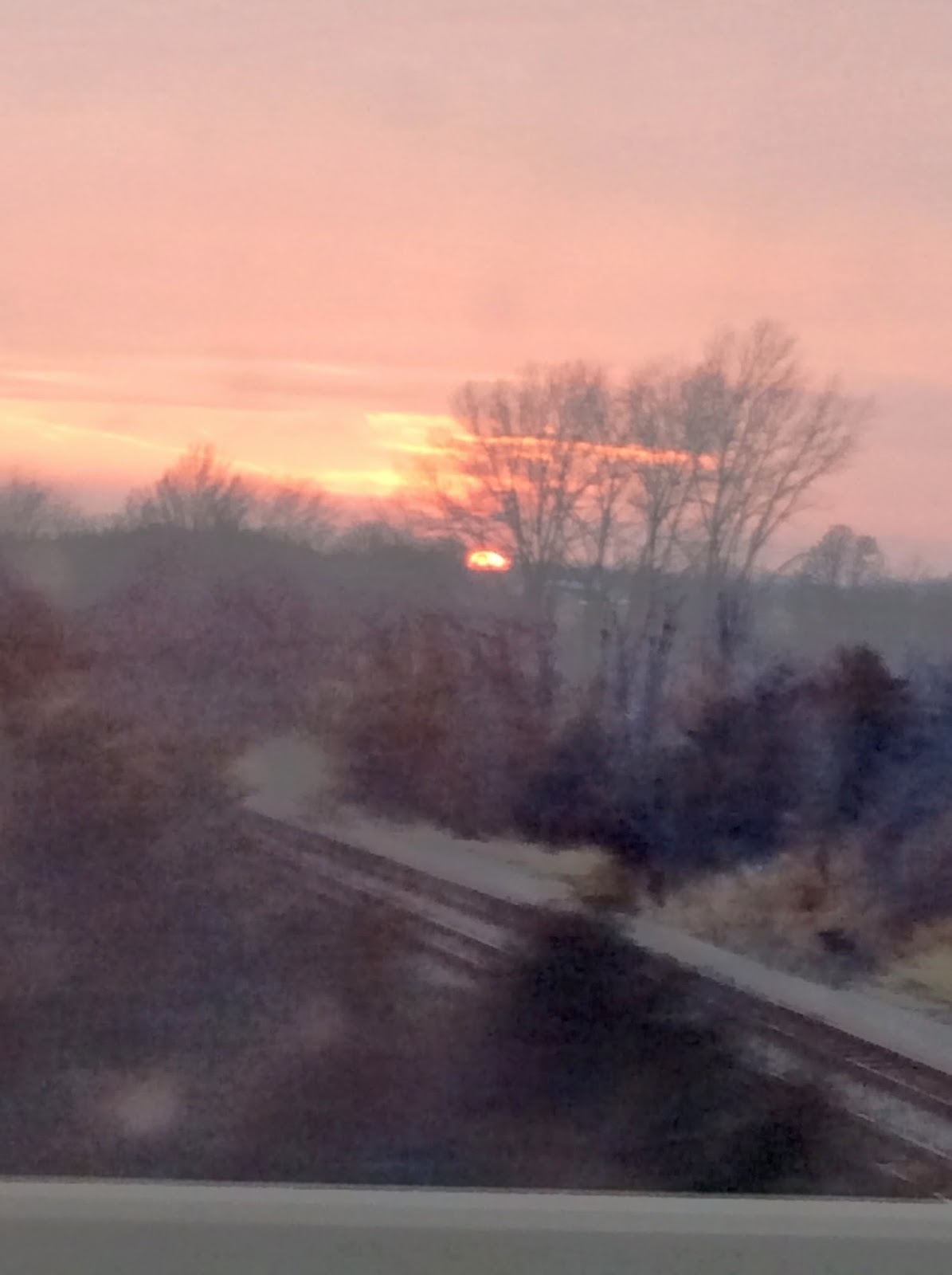
I have next to no expertise with a camera. I am in awe of what people who have skill can do with their cameras, and I’m frequently frustrated by what I can’t do. But I’m also fascinated by what I can capture, even in my ignorance and lack of skill. In the car with Husband a few nights ago, appreciating again the colors of winter in my adopted state, and setting sun, and gentle rolls of fields, I took as many pictures as I could. I liked so much of what I ended up with, even while I didn’t capture exactly what I saw out the passenger seat window. Expectations aside, I ended up with something beautiful. I was still participating in some form of seeing.

That play of expectations and my response and what I end up with in the end—it can make me crazy, but it also makes life something of a holy kaleidoscope. And I like that. A lot.

It struck me a few months ago, while walking an unruly bunch of young violinists back from the bathroom and wondering at the crazy swinging we do every day between off-the-wall-tired and brilliant-short jags of learning: what if one of our primary responsibilities while we wade through this life—this chaos—is to dip our hands into it as it flows past and make something of it? Sometimes it requires great skill to form something (smooth, perfect, compact maybe, or maybe towering and grand.) Sometimes all that is needed is to reach into the torrent and hold up, shining and raw, what I get hold of. Either way I am on a treasure hunt. Either way the best thing next to the find is showing it to you.


Subscribe to Dreamer by Email

Wednesday, January 21, 2015

Medley, 1/21/15


So my writing recently has focused on things other than for this blog. It’s a shift I’m enjoying, but being a little out of the blog habit makes emerging from my shell that much more uncomfortable. Today, though, I thought I’d share a few of the things that have been on my mind:

1. This article about phone use and boredom. It came out more than a week ago but I keep thinking about it. This idea that allowing the mind to wander is great for creativity is not new to me, and I have been working to make/keep space for that in my life. (My new battle cry, in fact, may be “Make space!”—not just for creativity but for life in general.) The idea that my smartphone gets in the way of or fills that space makes sense. I do not think I will download an app to help me with this problem, but it is something I’m attending to in my own life. The thing that actually fascinates me the most about this article, though, is the idea of boredom. I’ve maybe always equated boredom with restlessness, for example being in a situation that I had to pay attention to something I wasn’t interested in. The state I’m in when my mind wanders—I don’t have a lot of trouble getting there, and I enjoy it a lot. I’m not sure I’ve ever considered that boredom. What about you?

2. One of the books I’ve been burying myself in recently is The Gift: Poems byHafiz, translated by Daniel Ladinsky, entirely because of two poems I keep running across/thinking about: “With That Moon Language,” and “Dropping Keys.” I'm moving slowly through this book; I keep finding new favorites. I keep wanting to write more poems myself, and at the same time I feel tempted to quit. Maybe everything good has already been said.

2. And then this, a TED talk by Cristina Domenech, “Poetry that frees the soul,” about teaching poetry in an Argentinian prison: “And in that seventh circle of hell, our very own, beloved circle, they learned that they could make the walls invisible, that they could make the windows yell, and that we could hide inside the shadows.” Please make time for about 12 ½ minutes and subtitles. 


Subscribe to Dreamer by Email

Monday, December 15, 2014

Light: 12/15/14


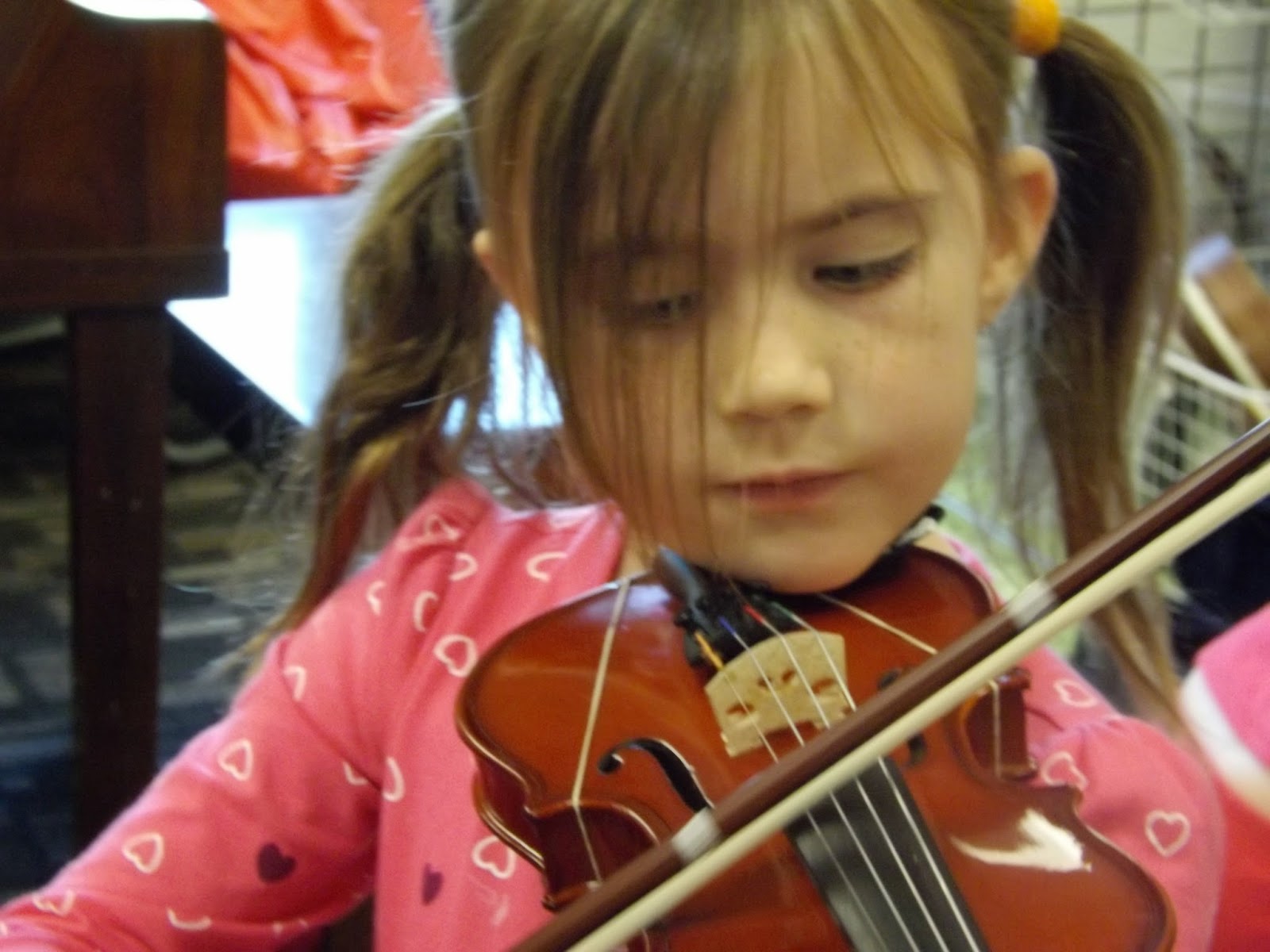
Every day I see this. During arrival/tuning/snack time, especially—they are experimenting, exploring, asking each other questions, teaching each other stuff. Every day I see this fire for learning igniting around the music room. Yes, they are tired and distracted after a long day at school. But still. I get to work with that fire.

Maybe one of these days when someone asks me what I do, instead of saying “I’m a violin teacher” I will tell the whole truth: “I am a violin teacher, a witness-er of miracles, a problem-solver, a counselor, a herder of squirrels, a maker of music, a fanner of flames.”


Subscribe to Dreamer by Email

Friday, November 21, 2014

Thankful, 2014: A Chance to Watch

1. At my students’ fall recital, sitting finally—momentarily—watching and listening. These milestones—you hit them whether you feel ready or not, whether you are sick or healthy, regardless of what else is happening in your life. We work for mastery. We work to capture the spirit of the piece. But what is on display in front of us is always deeper than those things, broader than the performance.

 So many dramas at play, and most of it hidden.

My pride in my students, and the fact that I am on the edge of my seat for each person who walks to the front of the church and bows and plays and bows again has everything to do with knowing them. Their stories, their struggles, their triumphs. Working with them I have gotten glimpses of these things, and I promise you even Twinkle is never the same piece twice.


2. Sitting with the pit band on the opening night of Fiddler on the Roof. Technically my first high school musical, if you don’t count the All-City Opera production of “The Magic Flute” I played in ninth grade. It is an odd and beautiful experience at 42, and I can’t get enough of watching. 

I am here to play, but my heart is with Oldest, on stage. Stage fright for the people you love is almost worse than stage fright for yourself, and it has nothing to do with your confidence in your loved ones or their abilities. As we start playing “To Life” the only thing tempering the adrenaline is the fact that I am used to playing despite it. Besides, I have to focus on what I am doing. 

And then it is his solo, and he is standing on a bench, hand raised in blessing—hand with new angles, and handsome—nailing it:

Za vasle zdorovie
Heaven bless you both, Na zdrovie
To your health, and may we live together in peace!

I get to watch, and I get to be part of the music—his music. My pride in him, the fact that I am on the edge of my seat—you know what that is. I have been watching him since what must be the beginning of time, and the story is rich and complex and I know I will never grasp all of it.

But I get to watch.


Subscribe to Dreamer by Email

Sunday, November 2, 2014

Violins!

Wednesday I brought the new violins to class, and the rest of the week was an even more pronounced mix of our usual brilliant moments and chaos. The anticipation building up to this week has been thick, and now that it has been released—oh. 

Wednesday pretty much everybody forgot about snack. They forgot to be squirrelly when we went to the bathroom. They were focused only on the violins, and for a certain amount of class I gave in to the noise and the spirit of discovery and watched them explore. My seasoned second year students helped the first year students, showing them how to put their shoulder rests on and how to tighten the bow, and then everyone just tried stuff. It was beautiful and loud, and I wish all of you could have witnessed it. The pictures, I think, tell the story well:


Subscribe to Dreamer by Email

Wednesday, October 29, 2014

Today is the Day


They have been waiting. And waiting. Practicing with box violins (mac and cheese boxes, stuffed with plastic bags and wrapped in turquoise duct tape, paint stirrers hot-glued in for necks) and dowel rod bows. They have been practicing, and singing and clapping and marching and dancing and listening. And waitingmostly patiently but not alwaysfor today.

It will feel differentthe real violins are heavier, and not as easy to get in the right spot on your shoulder. Today will feel like a step backward because the playing positions and bow holds will not be as familiar as they were yesterday. I promised them the ease will come back, and will arrive much sooner than it did the first time around.

Everything will be more breakable now, and we've had a few accidents in class, already. We'll deal with that when we need to.

Butsound. We are so close to making sound, and learning notes, and putting real pieces together, bit by bit. We are going to make music together.

Today is huge.


Subscribe to Dreamer by Email

Monday, October 13, 2014

Medley, 10/13/14

1. Tuesday evening: moonrise. A not-quite-full moon, pale and round and flat. The sky, too, is clear and pale. Peaceful. This week is busy, like so many of the rest of them, but the sky remains open and peaceful, changing and unchanging.

2. Later Tuesday evening: orchestra rehearsal, all Beethoven. The 7th Symphony, and Leonore Overture No. 3, and the Piano Concerto No. 4. I’m not sure how many times I’ve played any of these pieces, but the past performances are present, always. The piano concerto, for instance: I once got to play this with Daniel Barenboim as both soloist and conductor. The intensity and concentration of that performance, it turns out, is burned into my psyche. As we run through the piece with tonight’s soloist I can hear both the present version and the one from all those years ago. And this music is so good. 

3. Wednesday morning: I’m sitting alone in the waiting room at the dentist’s. All three kids are having checkups at once. I hear Youngest’s voice—she is singing “Let it Go” with all her heart. I imagine her face, and the way she must be moving in the dentist’s chair as she swoops for the high notes and dips for the low. “The cold never bothered me anyway—” I think she especially loves that line, and the meaning she intuits in it. The hygienist tells me later that they waited at the doorway of Youngest's  room until she finished the song. They did not want to interrupt.

4. Saturday: the last birthday cake of the season, chocolate with cream cheese frosting, sprinkled with dark chocolate curls and golden sugar. It struck me, looking at the finished cake, that the frosting works as a sealer, holding in moisture, at least as much as it sweetens and decorates. I’ve always thought of the frosting as the best part; I’ve never before thought of it as a kind of armor.

5. All week, each weekday afternoon: The Violin Project. These kids are young, and they're tired at the end of the day. It is a difficult time for intense focus. The room is often noisy. I have been trying to get them to be quieter—especially while I am tuning their violins. But this week I suggested that they use tuning time (which for them is waiting time) to help each other—second year students could help beginners with bow holds, playing positions, rhythms; older kids in general could help younger; second year kids could join forces to puzzle out new skills and pieces. The noise turned into something special. This is what I am looking for, at least as much as I am seeking order. What could happen, if we all keep learning and growing like this? 


Subscribe to Dreamer by Email

Wednesday, August 20, 2014

The Violin Project, Year 2: Notes from the First Day of Class


Seventeen is a big number. Seven returning students, ten new students. When I group them that way it all looks very manageable. All together they look like more than the sum of their parts. 

They were excited, yesterday, coming in. Eyes big. The new ones wanted to know when they would have violins. They are ready to play concertos. One child informed me, very seriously, “I’m doing violin because my mom said I had to.” One gave me five examples of How Fast A Learner I Am. We will move slowly, and that is hard but at the same time easier—so much less overwhelming than “Here’s your violin, this is how you hold it. Here’s your bow, this is how you hold it. Now play.” And I think we will have fun, regardless of how we ended up together in the first place.

I don’t know who was more nervous, the kids or I. For them I want to project calm and confidence, but every year is new, the territory fresh and a little wild, and every year I wonder if I am really up to this new year of teaching. I have trouble feeling calm.

And then we start, and everything’s okay.

We began yesterday with background music (Twinkle Theme and Variations) and coloring (treble clefs) and snacks, and worked our way into learning each others’ names, standing still, listening to and following instructions. The newcomers will be painting the fence, Karate Kid-style, for a while, and that tends to fly in the face of young peoples’ expectations. But it is like the scarf I have been knitting for months and months: day-to-day the progress is slow, and certainly not our culture’s usual way of acquiring things. But I got used to the slowness, and I enjoy the process. Recently—suddenly, it seemed—I noticed that the thing has length. Someday I will wear it and forget how long it took to make. Someday, suddenly, we will look at each other over our violins and say, “Look how much we’ve learned!”

Here’s what else I forget, and have to keep re-discovering: it’s not just every year that is new. Every day is new. Getting to know each other, fence-painting, problem-solving—we are in it together. What luck. I can’t wait.


For more about The Violin Project, click here, or visit our Facebook page.


Subscribe to Dreamer by Email

Saturday, August 2, 2014

So—July was a whole lot of traveling.


Now we’re home. A good part of this week has been spent puzzling out a schedule for the school year—for my teaching, for the kids’ school and activities, for everything else. I’m wondering how safe it is to drink lots of coffee while doing this. I was so excited to pay for the kids’ swim club on time, on top of all the Figuring Things Out! I did yesterday morning that I accidentally put the car into drive instead of reverse at the aquatic center and nearly drove down a big grassy hill. 

This time of year is a second January—looking forward, looking back. Last month’s travels are still fresh. The school year ahead is all theory, the outlines of it neatly arranging themselves on a grid. Things will not look this tidy in the thick of it, but that’s where the art lies, right? This is a thought I will try to hold on to.

I’ve been thinking a lot recently about Llonio the Gatherer from Lloyd Alexander’s Chronicles of Prydain. I read the books to Oldest and Middle years ago, and Llonio has stayed close—with his approach to life, his skill at using what came to him, the beauty of his outlook: “Trust your luck, Taran Wanderer. But don’t forget to put out your nets!” Because I keep running into this: What You Have and What You Don’t Have are two very important and special things. Yes, both can be harsh, painful, devastating. But you can also make magic, when you start playing with the two. This, too, is something to hold on to.

In the spirit of Llonio, I want to share some of my gatherings from this summer—some of the quieter, magical things that presented themselves along with what was planned:


Subscribe to Dreamer by Email

Wednesday, July 2, 2014

What I'm Doing This Week


I’m not sure why I thought I’d get a lot of writing in this week. I am at the Chicago Suzuki Institute with my daughters, filling up on music and technique and new friends and Everything Violin. And—most importantly—reminding myself why we’re doing this in the first place (We are doing this in order to grow, in order to become better human beings. Music, you see, is the medium as much as it is the final product, the art, itself. And our lives—they are the true art.)

Those are noble words. The actual work they describe is awkward and messy and really stinking hard, but it is interspersed with these wonderful moments. Kind of like practicing violin, itself, which when done right is not at all romantic, but instead involves things like practicing the same two notes over and over until they can be played well, and then over and over many times more, until they will never sound ugly again. You don’t necessarily want to be in the room for this process, but the results are worth it. 

There has been music-making this week, and understanding, and beauty. 

We are enjoying ourselves and also bordering on wiped-out. In my characteristic, extremely relationship-oriented/extremely introverted way, I half want to absorb more/connect more/converse more, half want to hide somewhere with a book. One daughter, apparently, talks in her sleep. (“Mom,” a voice just informed me out of the dark of our dorm room, “there are two butterflies in here.”) And to be honest, our moments of beauty and understanding are balanced with healthy doses of snippiness.

Overall though, I feel like we have been able to relax more this year. I prepared myself ahead of time for the comparison game—not that I’m not tempted to play (I am) but I am also (mostly) able to see it for what it is. I resolved early on that frog catching/rescuing (they are tiny and everywhere, crossing the sidewalks like ants,) as well as extra desserts, would be part of our daily schedule along with practicing and brushing teeth. And—luxury of luxuries—I brought an air mattress with me this year. Sleeping on the floor won’t hurt. This is all very good.

This feeling that there’s so much here, that I can’t possibly process it all, that I also don’t want to stop trying to process it all—that must be a good sign. This too, I think, is why we are here.

More about our Suzuki institute and workshop experiences here.


Subscribe to Dreamer by Email

Friday, May 30, 2014

Found: Old Yellow Notebook, Fall 1990


Why, exactly, it is so full of odds and ends is not clear. There is no title on the front, only notes of things I needed to remember during that first semester of college: an extra violin lesson before my professor left the country for a week or two, notes on an upcoming piano quiz. On the back are the phone numbers of the guys who convinced me to play in the band they were forming, an address with no name attached.

Inside is random, bits of everything important about the start of freshman year:

The beginning notes for an abandoned composition for violin—a chord, a rhythmic motif, a melody based on the pitches of the wind chimes on my parents’ patio. “story about person w/ eyes the color of peace” is written in that tiny up-and-down handwriting that filled barely a third of the college-ruled lines, that always seemed to float just above the blue line rather than sit neatly on it.

A list of things to pack for the dorm room: clothes, music, books, bicycle, typewriter, decorations. The glass unicorn bought in honor of “The Glass Menagerie” that years later actually did fall and break, losing the horn that made it so special. The doll received as a gift while a toddler in Japan, the books of Swedish  and Norwegian fairy tales from childhood, the thick new Webster’s College Dictionary and Thesaurus. Everything needed to continue as myself, everything needed to start this new life.

The rough draft of an essay written for admittance to the Honors Program, “The most important intellectual experience I have had to this point was learning how to communicate on paper.”

Unfinished letters, a list, plans for a never-sent care package—the skeleton of a breakup. So hard, and so necessary.

Notes from the first days of each class that first semester: Art and Literature in the Western World, a class that lingers in my heart and mind still; Class Piano; Music Theory; Intro to Philosophy (still I wonder about our section—if our inability as a group to correctly answer any of the TA’s questions was due to our lack of understanding of the nuances of philosophy or the nuances of language.)

A note written to a now-unknown friend during class: I’m really suspicious of a musician who isn’t impressed by any other musicians. 

A poem—I had forgotten how many times I started writing and gave up, frustrated by my clumsiness, by the stiffness of the words. It is truly clunky. Still, it is full of images I have come back to repeatedly, and also a dream I had forgotten.

A music list—“Strength, Comfort, and Identity Tape.”

If there is a theme to this notebook besides Fall 1990: First Semester of College, it could be The Things I Have Forgotten, or possibly A Vast Amount of Your Adulthood Has Been Spent Running Away From and Rediscovering This Girl (Abridged version: In Some Ways You Have Not Changed at All. More abridged: Still.) There is a silence in it, but also something breathing. Which brings me again back to that poem, and the dream: I was alone, my friends were gone. I sat drawing a picture of a tree, and as I worked a voice guided me. She told me exactly how to make the picture come to life: how to make the snow in the picture begin to fall—fat silent flakes drifting past dark branches, how to draw a squirrel to life to weave through silent flakes and dark branches.

I had forgotten that dream, but the image is alive again now within me.

The fact that all of it lives, still—I think that is the point. What we draw out of life, what we bring to life, what lives and breathes throughout a life—I am in love with that mystery, that art. Still.


Subscribe to Dreamer by Email

Tuesday, May 20, 2014

Found: Ghosts

Husband and I have committed the last two weeks before school gets out to going-through, straightening-up, purging the house of Stuff. I have been anticipating and dreading this time ever since we decided to do it. There’s too much of it in the house, this Stuff, and it is part junk, part treasure. Deciding which is a big job I would kind of like to continue avoiding. I am sustaining myself with fantasies of Order, and some kind of clean efficient spareness that is probably impossible, considering the five of us seem to be part hobbit. I also promised myself  a new project: sharing some of what I find here on the blog.


They’ve been waiting for me in the basement. In the boxes of homeschooling stuff, in the old toys that haven’t been touched or thought about for years, in the things broken/torn/dirty that I could not fix and could not throw away. The ghosts.

They beg to be kept, they beg to be thrown away: the papers that threaten to creep out of their boxes, plaster themselves over everything, overwhelm the house. The drawings from years past that whisper of round hands that created them, of time that has slipped away, of all the precious things I treasured, but maybe not quite enough. The homeschool papers that murmur sweet memories, yes, but then their tone sharpens—peppered with doubt, regret, feelings of failure. I can talk back to them, but still. They are unpredictable. One never knows how they will respond, if they will listen to reason. They are unsettled; they are unsettling.

That’s the thing about ghosts. Each page I pick up has a story, a memory, something of my children scrawled or glued or stickered across it. They are treasures, of course. But they are not my children. They are not our Now. They are merely the things that want to swallow up Now. I suspect they never get their fill.

I admit I face the ghosts in small batches. I tell myself it is a special time, this communing with them. An appointment, only. I let go of what I can, even though something in me fights letting the past slip away, reaches out to grab on to every memory to hold forever in my hands. I would rather hold on to Now. I re-box what I cannot throw, knowing we will meet again. Knowing that new ghosts will have gathered.

We will make our peace how we can.


Subscribe to Dreamer by Email